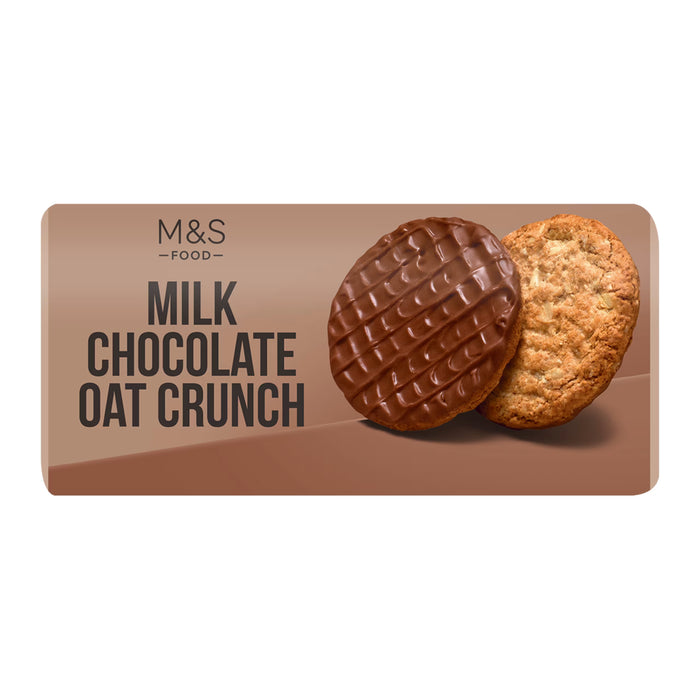
The brand story behind the packet
There is no well-sourced public origin tale for this particular Milk Chocolate Oat Crunch biscuit, so the honest story here is the M&S story behind the modern packet. Michael Marks established his first penny bazaar stall at Kirkgate Market in Leeds in 1884, using a £5 loan from Leeds warehouse owner Isaac Jowitt Dewhirst. At that original stall, Marks used the wonderfully direct slogan, “Don’t Ask the Price, it’s a Penny”. Thomas Spencer, born in Skipton, Yorkshire, in 1851, had worked as a bookkeeper for Dewhirst’s wholesale company in Leeds before joining Marks. It is a very northern beginning: markets, ledgers, hard sums, and the sort of retail clarity that did not require a lifestyle campaign.
From penny bazaar to food hall
Marks and Spencer became a partnership in 1894, with Spencer taking on office and warehouse responsibilities while Marks continued to drive the market-stall side of the business. The firm expanded through cities including Manchester, Birmingham, Liverpool, Sheffield, Bristol and Cardiff, before becoming a limited company in 1903. Food did not arrive at M&S from the very beginning. The company is recorded as beginning food sales in 1931, by which point it was already becoming part of the British high street rather than just a market success story. That matters for a biscuit like this, because M&S food has always carried a slightly different sort of recognition. It is not just a manufacturer’s name on a packet, but a shop memory as well.
The St Michael shadow
For much of the twentieth century, many shoppers would have associated Marks & Spencer goods with the St Michael name. Introduced in 1927 and registered as a trademark in 1928, St Michael was named after Michael Marks by his son Simon Marks. By 1950, virtually all goods sold by Marks & Spencer used the St Michael brand, and that stayed broadly true for decades. The name was dropped in 2000 as part of a wider rebranding, with food halls becoming M&S Foodhall. So, if you remember St Michael labels from shirts, knickers, cakes or biscuits, you are not imagining a parallel universe. The modern M&S packet is part of the same family tree, just with the old label tidied away.
Why M&S food feels different
M&S made a large part of its reputation through own-label goods and close relationships with suppliers, especially during the years when the company was strongly associated with British-made products. That does not mean every modern item has a quaint little origin story involving a flour-dusted baker and a brass plaque. Corporate history loves that sort of thing, usually a bit too much. But it does explain why an M&S biscuit carries a particular set of expectations. The food halls became a place where shoppers looked for familiar British formats done neatly: biscuits, cakes, puddings, sandwiches, tins, jars and all the small edible decisions that keep a household civilised.
A biscuit with a passport problem
For British shoppers in Canada, the pull of a packet like M&S Milk Chocolate Oat Crunch is rarely about novelty. It is about recognition. It is the sort of thing you might have bought on the way home from work, added to a basket with milk and a ready meal, or found in a cupboard when visiting someone who definitely owned matching mugs. In Canada, that same packet can feel oddly specific, like hearing a familiar accent in a supermarket aisle. Oats, chocolate, tea, and the quiet belief that biscuits are a legitimate planning category. That is the small comfort The Great British Shop understands, and frankly the kettle was already halfway on.